
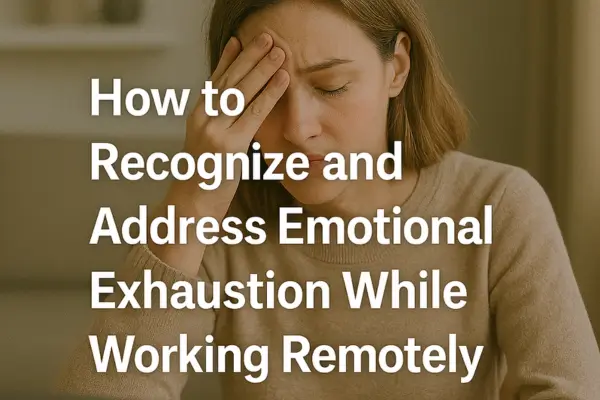
Remote work offers freedom and flexibility—but it also brings unique emotional challenges. Without in-person interaction, clear boundaries, or daily variety, many remote workers experience emotional exhaustion: a state of deep fatigue that affects both the mind and body.
This type of exhaustion goes beyond being “tired.” It can lead to irritability, lack of motivation, disconnection, and even depression. The worst part? It often builds slowly and silently.
In this article, you’ll learn how to recognize the signs of emotional exhaustion, understand what causes it in remote work environments, and—most importantly—how to address it before it spirals out of control.
What Is Emotional Exhaustion?
Emotional exhaustion is a state of chronic emotional depletion. It’s caused by prolonged stress, mental overload, and lack of recovery time.
Key signs include:
- Feeling emotionally “numb” or detached
- Losing interest in things that once brought joy
- Becoming easily overwhelmed or irritated
- Feeling like every task is “too much”
- Difficulty sleeping or constant fatigue
- Cynicism or disconnection from work and people
It’s often a precursor to burnout, and it’s especially common in remote work where stress can go unnoticed.
Why Remote Workers Are Vulnerable
Several aspects of remote work can contribute to emotional exhaustion:
- Isolation: Lack of face-to-face connection
- Overwork: No clear start/end to the day
- Hyper-responsiveness: Feeling like you must reply instantly
- Lack of variety: Working, living, and resting in the same space
- Emotional labor: Masking your struggles through a screen
Without intentional breaks and boundaries, it’s easy to slide into survival mode.
Step 1: Name and Accept What You’re Feeling
The first step to healing is recognizing and validating your emotional state.
Ask yourself:
- Have I been feeling disconnected from myself or others?
- Do I feel emotionally “empty” more often than not?
- Have I been trying to push through rather than pause?
- Do I feel guilt when I rest or stop?
Don’t judge your exhaustion—meet it with compassion. This is a signal, not a weakness.
Step 2: Take a Full Digital Break (If Possible)
Screens are mentally and emotionally draining—even more so when your entire workday happens online.
Take a tech break by:
- Logging off work early (if allowed)
- Spending a full day without screens on the weekend
- Putting your phone on airplane mode for a few hours
- Going for a long walk with no headphones or notifications
Disconnecting gives your brain a chance to reset from constant stimulation.
Step 3: Rebuild Your Energy in Layers
You can’t fix emotional exhaustion with one nap or weekend. Think of recovery as a layered process:
Physical: Prioritize sleep, movement, and hydration
Mental: Reduce input—say “no” to extra tasks or calls
Emotional: Talk to a friend, therapist, or journal it out
Spiritual (if applicable): Reflect, meditate, or seek silence
True recovery happens when all parts of you are tended to, not just your calendar.
Step 4: Reevaluate Your Workload and Responsibilities
Sometimes emotional exhaustion comes from doing too much for too long—often without realizing it.
Reflect on:
- Which tasks drain vs. energize you?
- Are you working past your official hours?
- Have your responsibilities quietly increased?
- Are you trying to be available 24/7?
Talk with your manager or clients if your current workload is unsustainable. Advocating for yourself is part of staying well.
Step 5: Create Emotional Recovery Windows During the Day H3
You don’t need to wait for burnout to take care of yourself. Build in micro-recovery breaks that help you emotionally decompress.
Try:
- 5-minute “nothing” breaks—no input, no pressure
- Stepping outside for sun or fresh air
- Listening to music that soothes or uplifts
- Writing down one thing you’re grateful for
- Hugging a pet, plant, or pillow (yes, really)
Small moments of emotional care accumulate into resilience.
Step 6: Set Boundaries Around Energy-Draining Interactions
Some tasks or people leave you more depleted than others. That doesn’t make you rude—it makes you human.
To manage this:
- Limit back-to-back Zoom calls
- Decline unnecessary meetings or reschedule
- Use async tools when possible
- Take 10 minutes of quiet time after intense interactions
- Say “not right now” to requests that stretch your capacity
You don’t need to please everyone. You need to preserve your well-being.
Step 7: Reconnect With Meaning and Purpose
Exhaustion often comes from disconnection—not just from others, but from purpose.
Ask:
- Why did I choose this work in the first place?
- What small part of my work brings meaning or pride?
- How can I shift my focus from tasks to impact?
Sometimes meaning is in the details: helping a client, solving a problem, learning something new.
Step 8: Give Yourself Permission to Slow Down
Remote culture often glorifies speed and responsiveness. But slowness is healing.
Practice slowing down by:
- Taking longer, deeper breaths during the day
- Moving through tasks with presence, not urgency
- Choosing depth over speed in your communication
- Letting one thing be “enough” for today
Rest is productive when it helps you come back stronger.
Step 9: Ask for Help—Even If You’re Not Sure What You Need
Emotional exhaustion is not something you should carry alone.
Reach out to:
- A therapist or coach who understands remote work
- A trusted friend who will listen without fixing
- Your team lead or HR (if your workload needs adjustment)
- Online communities or forums for mental health
You don’t need perfect words to ask for support. You just need the courage to start the conversation.
Step 10: Make Space for Joy—Even in Small Doses
Joy is a powerful antidote to emotional exhaustion—but it often disappears first.
Bring it back by:
- Revisiting a childhood hobby or interest
- Watching a comedy, not just serious content
- Doing something silly, unproductive, or creative
- Cooking your favorite meal just for you
- Celebrating small wins—even if they seem minor
You don’t have to earn joy. You just have to make room for it.
Final Thought: Exhaustion Is Not a Personal Failure
If you’re emotionally exhausted, you’re not broken—you’re human.
You’ve likely been doing your best, under unusual conditions, for longer than expected. The answer isn’t to push harder—it’s to pause, reflect, and restore.
Remote work can be sustainable—but only if you include your emotional needs in the equation.
You deserve to feel alive—not just functional.